AI hallucinations are rarer than they used to be, and that is exactly why the ones you miss now cost more. Nobody double checks an answer that looks right, and these days most wrong answers look right. If you are not a specialist in what you asked, a confident wrong answer does not feel wrong. It feels like help.
AI Hallucinations Are Down, But the Misses Cost More
My read is that AI making things up happens less often than it did a while back, but when it does happen, the damage is bigger. The old failures were easy to spot because they were silly. The current ones are built from real parts, delivered in a calm voice, and formatted exactly like a correct answer.
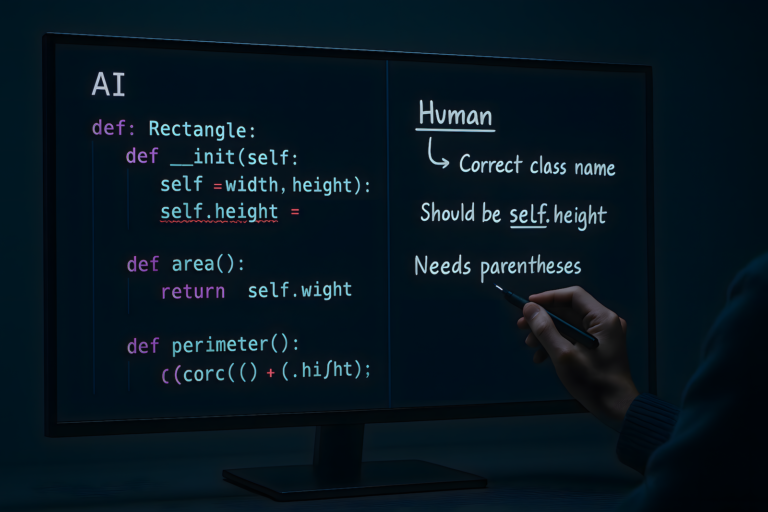
Code shows this best. A recent study of invented package names found per-model rates of about 3.6 to 5 percent of package mentions across the newest frontier models, and the title of that paper says it plainly: the range shrinks, the threat remains. The threat is real because criminals register the package names AI coding assistants made up, so developers who install them unknowingly may download malware, a supply chain attack now called slopsquatting. A smaller number of wrong answers does not help when each one is dressed identically to a right one.
Why Does AI Hallucinate? It Predicts, It Does Not Look Up
A language model generates text one piece at a time, choosing what is likely to follow, and it does not go and check anything. A hallucinated answer has the same confident tone as a correct one, so fluency is no signal of accuracy. That is the whole trap. coddy
It gets worse as models get bigger. Researchers who tested GPT, LLaMA and BLOOM families found that smaller models tend to decline questions they cannot answer, while larger models more often produce a confident sounding but wrong answer, as The Register reported. So the AI confidently wrong problem is not a leftover bug waiting for a patch. It is a side effect of building a system that is rewarded for answering.
I broke down five patterns where AI keeps failing, and fluency mistaken for correctness is the one that matters here. The output sounds finished, so the review step quietly gets skipped. That is how a wrong answer gets from a chat window into something real.

ChatGPT Hallucination, Claude Hallucination, and Gemini: Three Different Habits
The people I know who build with AI mostly split between ChatGPT Codex and Claude Code, so most of what I hear comes from those two. Every model hallucinates, but they do it with different personalities, and knowing the personality helps you catch it.
A ChatGPT hallucination comes with its chest out. It says the wrong thing the way it says the right thing, confident the whole way through. Claude is the one with the memes, because it will give you code and then correct itself later. I have seen the Claude hallucination side of it in my own brainstorming and writing sessions, when I am trying to say something and the model makes something up. That happens less than it did months or years ago, but it still happens, and if you are not a specialist you get swallowed by it.
Gemini is a different animal for me. I only use it for image generation and video creation, so I do not judge it on code, but the pattern is consistent. It already has a reference, and if the prompt is wrong, it builds up from the wrong prompt instead of pushing back. A bad premise from you becomes a polished result from it.
AI Sycophancy: What Happens When You Correct It
Catching the first wrong answer is only half the problem. The second half is what the model does when you correct it, and this is where models split in two directions.
The first direction is acknowledge, note it, and do it again. The model takes the correction, says so, and then hands back the same mistake. The second direction is the complete 180. You correct the model and it collapses into agreement, goes passive, stops researching, and stops correcting anything, so you are left sparring with something that no longer pushes back.
That second behavior is AI sycophancy, and it has been measured. Stanford researchers tested ChatGPT-4o, Claude Sonnet and Gemini 1.5 Pro on math and medical questions and defined sycophancy as models prioritizing user agreement over independent reasoning, finding it in roughly 58 percent of cases in their SycEval study. Those were older models, so the exact numbers have moved, but the split inside them is the useful part. Progressive sycophancy, where pressure moves the model to a correct answer, occurred in about 43.5 percent of cases, and regressive sycophancy, where it moves to an incorrect answer, occurred in about 14.7 percent.
Claude Code users have a public record of their own. A GitHub bug report titled “Claude says ‘You’re absolutely right!’ about everything” shows a user who answered “Yes please” to a question about removing a code path and was told they were absolutely right, even though they never made a statement of fact that could be right. The Register noted more than 50 comments from other developers on it, in its coverage of the complaint.
Why the Memes Exist
Memes do not get made when there is nothing to worry about. Nobody posts about how perfect their app is, you only hear about a product when it stops working properly, and AI is no different. The jokes about confident wrong answers are a public log of a failure people keep hitting.
Some of those failures leave the meme and enter the real world. Soundslice, a sheet music scanning service, added support for ASCII tablature after finding screenshots of ChatGPT conversations in its error logs where the chatbot told users to submit tabs to a feature the app never had, a story 404 Media called gaslight driven development. In another case, a Reddit user said GPT-5 gave wrong information on basic facts over half the time, and when they checked GDP figures, the chatbot listed Poland above $2 trillion while the IMF puts it near $979 billion, as Futurism reported. The user only caught the errors because some answers seemed suspicious, and wondered how many wrong answers they had accepted as true. That question is the real cost of AI hallucinations.
How to Catch AI Hallucinations: The Sparring Match
Sparring matches are how I work with AI, and we do them all the time. When the model answers confidently and I know it is off, I correct it by raising the issues and the facts, and the answer gets worked out in a back and forth of ideas. That is collaboration, and it is the only way of working with AI that I trust.
Three rules keep the sparring honest:
Bring facts, not pressure. Because of AI sycophancy, a bare “are you sure” can move a model in either direction, and the SycEval split shows pressure sometimes lands on a wrong answer. A specific issue or fact the model has to deal with is a test, while pressure alone just invites it to fold.
Read what the correction does. A real correction changes the answer and gives a reason. An acknowledge and repeat changes nothing and sounds sorry. A 180 changes everything and sounds agreeable, and that is the one most likely to lead you off a cliff.
Spar where you can win. The method only works if you know enough to raise real issues, which is why a non specialist gets swallowed. Outside your own lane, check the source instead of the chat, and keep evaluating the output yourself, because evaluating AI output is a different skill from producing the work and it weakens when you stop practicing it.
You can also cut the problem off earlier. A prompt written like a spec tells the model what to return when it has nothing to return, which is the idea behind prompt contracts, where an extractor that invents product names on a review that has none gets an explicit empty result instead. And when the output goes into real work, it stays unverified until a human checks it. On my QA retainer, an AI agent’s fix is not done until I check it against the acceptance criteria and against what the fix was supposed to do, because a fix can pass its criteria and still be wrong.
If an AI agent is writing the code and you are the only person checking it with real user intent, read how I QA AI generated code on a retainer next.