The failures are not random. After watching AI break across enough different contexts — content pipelines, QA workflows, SEO systems, automation stacks, hiring processes, classrooms — a pattern becomes visible that has nothing to do with which model you used or how good the prompt was. The failure is almost always the same category of mistake dressed in different technical clothing. Once you can see the pattern, you start recognizing it before the failure happens rather than after. That is the only useful thing a failure analysis can deliver.
This is not a catalog of AI disasters or a hype-versus-reality take. Those posts exist in abundance and they all perform the same move: here is what went wrong out there, here is what you should do differently, here are our services. What follows is a different kind of document. It is a field record of failure modes observed across real builds, real client work, and real production systems, with the pattern named as precisely as possible so it can be recognized in the next context before it costs anything.
The Pattern Is Not the Tool
The instinct when AI fails is to blame the model. Wrong model, wrong prompt, wrong tool for the job. Sometimes that diagnosis is correct. More often the failure happened upstream of the tool selection, in a decision about where AI sits in the workflow and what it is expected to do there.
The pattern that connects almost every AI failure mode is this: something that required judgment got handed to a system that can only produce output. Judgment is the ability to weigh context, history, stakes, and ambiguity and arrive at a decision that accounts for all of them. Output is a statistically plausible response to an input. These are not the same thing and treating them as interchangeable is where most AI implementations go wrong. The tool did not fail. The architecture failed because it put the tool in a position that required something the tool cannot provide.
Every failure mode below is a variation on that same root. The technology changes, the domain changes, the stakes change, but the underlying mistake is consistent enough to name.
| Failure Mode | Root Cause | Common Example | Prevention Signal |
|---|---|---|---|
| 1. Removing the Judgment Layer | Human review step eliminated because output “looks good” | Autoblog pipeline publishing volume without viewpoint or experience | Where does this workflow require a human decision on value, stakes, or taste? |
| 2. Automating Before Understanding | Building automation on a process that wasn’t fully mapped | AI SEO content that passes structure checks but fails ranking | Have you manually run the process end-to-end and validated the real success criteria? |
| 3. Fluency Mistaken for Correctness | Treating confident, well-written output as truth | AI detectors flagging good human writing or passing bad AI writing | Does this output need adversarial review or domain expert validation? |
| 4. The Context the Model Doesn’t Have | Model reasoning from incomplete or fragmented information | Logic grouping by surface similarity instead of domain rules | What hidden context (history, strategy, edge cases) is missing from the model’s view? |
| 5. Scaling a Broken Process Faster | Taking a flawed human process and multiplying its speed/volume | EdTech tools that worked in pilot but collapsed at scale | Is the underlying process actually sound at human speed before accelerating it? |
Failure Mode 1: Removing the Judgment Layer
The most common AI failure mode is also the most avoidable. A workflow gets automated, the human review step gets removed because the AI output looks good, and the failure that follows is not caught until it has already done damage. The autoblog experiment documented on EAI is a clean example. The pipeline worked technically. Posts were generated, formatted, and published without error. What the automation could not produce was posts with a point of view, posts that drew on real experience, posts that gave a reader something the SERP AI overview could not replicate. The judgment layer, the human decision about whether a post was worth publishing and why, had been removed. The system produced volume. Volume without judgment is noise. What happens when you let AI think for you documents exactly what that looks like from the inside.
The judgment layer failure is not always this visible. Sometimes it looks like a content calendar that technically fills every slot but produces nothing worth reading. Sometimes it looks like an AI customer service bot that correctly resolves the query in the database while completely misreading the emotional state of the customer. Sometimes it looks like an AI resume screener that filters out the best candidate because their career path was unconventional. In every case the system did what it was built to do. The failure was in the decision to remove the human judgment that would have caught what the system missed.
Failure Mode 2: Automating Before Understanding
The second failure mode is building automation on top of a process that was not understood before the automation started. The failure does not appear immediately because the automation runs without errors. It appears later, when the output has been wrong in a consistent direction for long enough that the damage is measurable.
AI SEO content generation is where this failure mode is most visible at scale. A site owner automates content production before understanding which content actually drives the outcomes they need. The automation produces posts that are keyword-present, structurally correct, and statistically indistinguishable from intentional content. Google’s classifier disagrees. Why AI-generated SEO content gets filtered covers what the classifier is actually looking for and why fluent output is not the same as rankable content. The automation did not cause the failure. Building the automation before understanding the system it was operating inside caused the failure. AI and WordPress SEO failures documents the specific WordPress implementation version of this, where the automation and the platform interact in ways that compound the underlying problem.
The same failure mode appears in QA. AI-generated code that passes the test suite and fails in production is not a testing failure. It is an automation-before-understanding failure. The tests were automated before the engineer understood which behaviors in the production environment the test suite was not covering. The AI generated code that satisfied the tests. The production environment had requirements the tests did not encode. Testing AI-generated code in a hybrid QA workflow covers what a review process looks like when it is designed to catch this specific failure mode rather than trust the test result as the final signal.
Failure Mode 3: Fluency Mistaken for Correctness
The third failure mode is the one with the most institutional consequences. AI output is fluent. Fluency is not correctness. A model that produces a grammatically perfect, well-structured, confidently stated wrong answer has failed in a way that is significantly harder to catch than a model that produces an obviously broken output.
The AI detection industry was built on a misreading of this failure mode. Early language model output had a detectable statistical signature: low perplexity, high uniformity, predictable phrasing patterns. Detectors were trained on that signature. Em dashes appeared frequently. Certain transition phrases appeared frequently. “In today’s fast-paced world” appeared with such regularity that it became a meme. The detectors encoded these surface patterns as signals of AI authorship. Then the models improved, prompts became more specific, and the surface patterns disappeared. The detectors did not update. They kept measuring the 2022 statistical fingerprint against 2026 output and calling the mismatch a detection.
The result is an institutional failure that operates at scale. A resume written with AI assistance to organize genuine experience gets flagged as fabricated. A student research paper that synthesizes real sources through an AI drafting pass gets treated as plagiarism. A blog post that reads at 8 percent AI detection because the curation pass removed every surface tell gets published while a post that reads at 94 percent because the author has an analytical voice gets held. The detector is not measuring AI authorship. It is measuring the absence of the specific surface patterns that appeared in training data from a different era. The witch hunt that followed the original observation is not based on evidence. It is based on social transmission of a signal that was never validated and is now actively wrong.
The employer who rejects a resume for AI assistance is not protecting against misrepresentation. They are protecting against a surface pattern. The teacher who runs papers through an AI detector and calls the result a finding is not measuring understanding. They are measuring a proxy that stopped working. The question that matters is whether the person understands what they produced and can defend, apply, and build on it. No detector answers that question. Only engagement with the person does. AI fatigue is not intelligence covers the broader version of this pattern, where the performance of AI skepticism gets mistaken for the substance of critical thinking.
Failure Mode 4: The Context the Model Doesn’t Have
The fourth failure mode is consistently underestimated because it is invisible until the output is wrong in a specific way. The model does not have the context that would have changed the answer. It produces a response that is correct given what it knows and wrong given what it does not know. The gap between those two states is where the failure lives.
AI logic grouping failures documents a specific version of this: the model groups items by surface similarity rather than by the domain logic that would correctly classify them. The output looks reasonable. It is wrong in a way that only someone with domain knowledge would catch. The model did not fail to reason. It reasoned from incomplete context and produced a locally valid but globally incorrect result.
Self-imposed token limits as a search blind spot covers the infrastructure version of this failure mode: AI search systems that truncate context in ways that systematically exclude the information that would change the answer. The failure is architectural, baked into how the system manages context rather than into any single query. Fragmentation in AI systems covers what this looks like when multiple AI components operate with different context windows and no shared state, producing outputs that are individually coherent and collectively wrong.
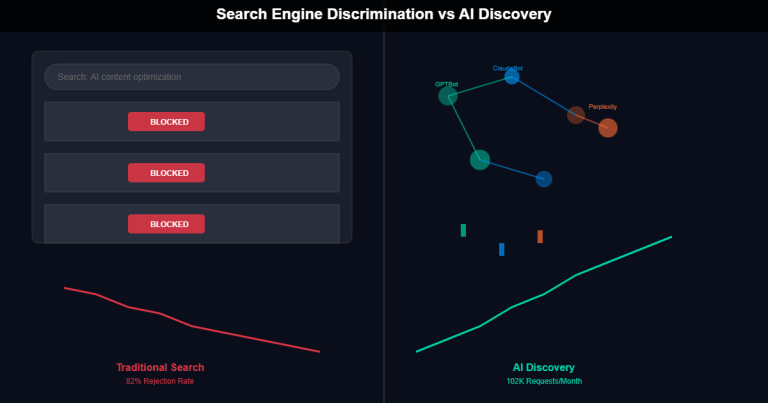
The context failure mode is particularly relevant in content and search because both domains are deeply contextual. A post that ranks for the wrong query because the model did not have the site’s full keyword strategy in context. A chatbot that gives technically correct guidance that is wrong for the specific customer’s account situation. Search engine discrimination against AI content covers how Google’s classifier operates on context signals that most AI content pipelines are not designed to produce, which is a context failure at the system architecture level.
Failure Mode 5: Scaling a Broken Process Faster
The fifth failure mode is the most expensive because the damage scales with the automation. A process that was broken at human speed gets automated and becomes broken at machine speed. The failure rate stays constant. The volume multiplies. The cost of the failure grows proportionally until something forces a stop.
EdTech AI failures documents this pattern in the education context, where AI tools that were piloted at small scale and produced acceptable results at low volume failed visibly when deployed across larger populations with more varied inputs. The tool did not change. The scale changed. The failure mode that was present but manageable at pilot scale became unmanageable in production.
The same pattern appears in every domain where AI automation gets deployed before the underlying process is validated. Customer service automation that handles the easy cases correctly and fails on the hard cases at high volume. Content generation pipelines that produce acceptable output for mainstream topics and fail on specialized topics at scale. Hiring filters that work correctly on the dominant candidate profile and fail systematically on edge cases while processing thousands of applications. AI treated like a dirty word covers the institutional response that follows these failures: the tool gets blamed, gets banned, and the underlying process problem that the tool exposed never gets addressed.
What the Pattern Tells You Before the Next Failure
The pattern is consistent enough to be predictive. Before deploying AI in any workflow, the failure mode question is not “what could go wrong with the model” but “where does this workflow require judgment, what context does the model not have, and what happens if fluent output gets treated as correct output at the scale I’m planning to run.”
Those three questions catch most of the failure modes documented above before they reach production. The judgment layer question identifies where human review is non-negotiable. The context question identifies what structured inputs the model needs to produce reliable output. The fluency-versus-correctness question identifies where the output needs adversarial review rather than a quality check.
Ghost in the Shell and AI’s tech reality gap covers the longer arc of this pattern: the distance between what AI appears capable of in a demo and what it actually does in production is not a bug in the technology. It is a property of how the technology works, and designing around it rather than against it is what separates workflows that hold up from workflows that fail on a schedule.
The pattern does not mean AI is not useful. It means AI is useful in specific configurations and fails in predictable ways outside them. That is not a criticism of the technology. It is the same thing that is true of every tool that exists. The ones who extract the most value from it are the ones who know where it breaks before it does.