AI resume screening is sold to HR teams as an efficiency tool that surfaces the best candidates faster. What it actually does depends entirely on how it was trained, what it was optimized for, and whether anyone has tested its outputs against reality. Most organizations using AI resume screeners haven’t done that testing, which means they’re operating a system that could be filtering out qualified candidates based on criteria nobody explicitly chose.
Understanding what AI resume screeners actually do requires looking past the vendor pitch. These systems aren’t reading resumes the way a human does. They’re pattern matching against training data that reflects past hiring decisions, and past hiring decisions reflect the biases, preferences, and structural advantages of the people who made them. This isn’t a fringe concern, it’s the documented behavior of multiple commercially deployed systems. If you’re on the QA side of one of these deployments, testing AI systems in production means taking the bias question seriously rather than treating it as someone else’s problem.
What These Systems Are Actually Optimizing For
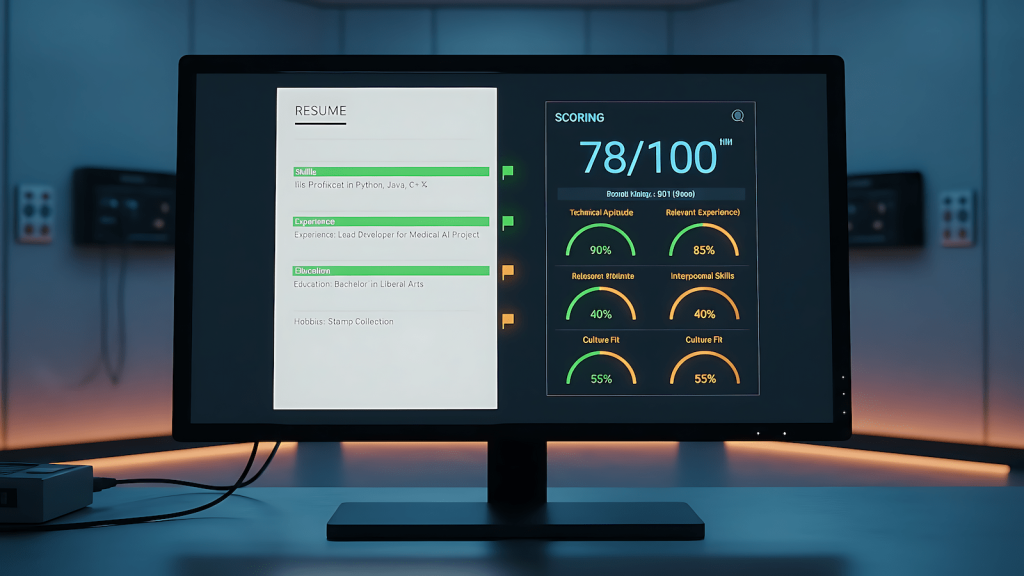
Resume screeners are typically trained on one of two things: explicit criteria defined by the employer (required skills, experience levels, education thresholds) or historical hiring patterns (what resumes from previously hired candidates looked like). The first approach produces systems that filter mechanically against a checklist. The second produces systems that reproduce the demographic and educational profile of past hires, which may have no relationship to job performance.
Keyword matching is the dominant technique in most commercial screeners, even those marketed as AI-powered. A resume that uses “machine learning” gets scored differently from one that says “ML” gets scored differently from one that says “predictive modeling” — all of which may describe identical experience. Candidates who know how to optimize for keyword matching score higher than candidates with equivalent or superior skills who don’t. That’s a measurement problem, not a talent identification problem.
How to Test a Resume Screener
The minimum viable test for an AI resume screener is a blind equivalence test. Create two versions of the same resume with identical qualifications, experience, and skills. Change only the demographic signals: names that read as different ethnicities, graduation years that imply different ages, universities with different prestige signals. Run both versions through the screener and compare scores. If the scores differ significantly, you’ve found a bias source. This isn’t a theoretical concern, it’s a documented failure mode in multiple commercial products.
Keyword sensitivity testing reveals how brittle the scoring logic is. Take a resume that scores above the threshold and systematically substitute synonyms for key terms. Swap “managed” for “led,” “Python” for “Python programming,” “collaborated” for “worked with.” Track how score changes correlate with term substitutions. A system that produces dramatically different scores for semantically identical content is measuring vocabulary match, not qualification.
False negative testing is the hardest to do without ground truth data. Identify candidates who were manually reviewed by humans and hired despite not passing the screener’s initial threshold. Compare their profile to the screener’s output. False negatives that concentrate in specific demographic groups indicate the screener is filtering on something other than job-relevant criteria.
What the Results Actually Mean
The goal of testing an AI resume screener isn’t to certify it as unbiased that’s a higher bar than any current system meets. The goal is to characterize its failure modes specifically enough to make an informed decision about how to use it. A screener with known keyword sensitivity issues can be used with human review of near-threshold candidates. A screener with documented demographic bias in scoring requires either retraining or replacement.
Documentation matters here regardless of what you find. If the system shows problematic behavior and you have written evidence of it, the organization is on notice. If the system shows problematic behavior and nobody tested it, the organization is exposed in a different way. Either way, understanding how AI systems fail is a prerequisite for using them responsibly in decisions that affect people’s livelihoods.
Testing AI resume screeners is QA work. It requires the same discipline as testing any system that makes consequential decisions at scale: define what correct behavior looks like, build test cases that cover the boundary conditions, document the results, and report what you find. The fact that the system is making hiring decisions doesn’t make it exempt from that standard it makes that standard more important.