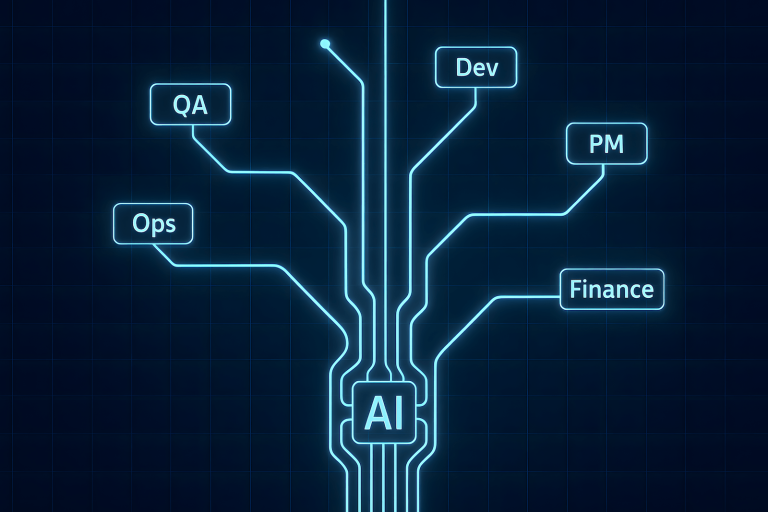
Getting into AI without starting over is possible for most working professionals because the skills that make AI systems actually work in production (structured thinking, quality assurance, workflow design, stakeholder communication) are the same skills that experienced QA engineers, developers, project managers, and operations professionals already use daily. The AI education industry doesn’t want you to know that. Anxiety sells courses. Confidence doesn’t.
This cluster covers what you actually need to know and what you don’t.

The Truth Nobody in AI Education Tells You
The AI education industry runs on your anxiety. The job itself is far simpler than the curriculum builders are selling. An AI engineer in 2026 is someone who can connect models to real systems, validate that the output is correct, diagnose when it isn’t, and build something that works reliably under production conditions. That description fits a lot of people already working in tech who have never called themselves AI engineers.
The title changed. The work is mostly familiar. The gap is smaller than the course catalog implies.
What happens to your thinking when you let AI do it for you is the question that actually matters for career development in this space. Outsourcing cognitive tasks to AI has measurable costs to retrieval, judgment, and problem-solving ability when the practice is undisciplined. The professionals who thrive with AI are not the ones who use it most. They’re the ones who use it deliberately and maintain the underlying skill base that lets them catch what AI gets wrong.
Getting Started Without Drowning in Hype
Getting started in AI, ML, and data science doesn’t require a PhD, a bootcamp, or a complete career pivot. It requires a staged approach: Python fundamentals, a working understanding of how models are trained and evaluated, and one real project that demonstrates you can apply the knowledge to a problem that matters.
The staged roadmap that post covers is built for people who are already employed, not full-time students. The assumption is that you have ten to fifteen hours a week, not forty. That changes which resources are worth your time and which aren’t.
Getting a job in AI, ML, or data science is a portfolio problem more than a credential problem. Hiring managers in 2026 are looking for evidence that you can ship something functional, not evidence that you completed a curriculum. A GitHub repo with one working project that solves a real problem outperforms a certificate from a platform you paid for.
Transitioning From Where You Already Are
Transitioning from an existing job into AI, ML, or data science is not the same as starting from scratch. QA engineers already do evaluation work, which is exactly what AI systems need. Developers already understand systems architecture, which is what AI pipelines require. Project managers already handle scope, stakeholder communication, and delivery timelines, which are the constraints that make AI projects succeed or fail.
The transition is about layering AI-specific vocabulary and tooling onto an existing skill base. The faster path is not to abandon the existing skill base in favor of becoming a generalist data scientist. The faster path is to become the person in your current domain who understands how AI actually works.
Understanding the Technology
What Is Engineered AI and why the term finally matters defines the framing this whole site operates on. AI as a tool that is structured, validated, and deployed with engineering discipline, not as a magic system that produces answers. Understanding that framing changes how you approach learning it, building with it, and evaluating whether it’s working.
What is agentic AI and the three types you need to know is the conceptual layer that increasingly matters for anyone working in tech. Single-task specialists, multi-step coordinators, and autonomous decision-makers have different failure modes and different integration requirements. Knowing which type a system is determines what oversight it needs.
The silent blind spot in AI search and self-imposed token limits is a real technical constraint that affects how AI systems consume and synthesize information. Understanding it matters for anyone building systems that rely on AI to read, process, or summarize content.
Building While Learning
Learning game development with AI through custom 404 games is what applied learning actually looks like: a real problem (404 pages are a dead end), a defined scope (build a playable game in JavaScript), and a deliverable that exists at a public URL when you’re done. The skill acquisition happens inside the project, not before it.
GPU wattage versus inference performance tradeoffs and multimodal LLMs locally and edge AI on low-power devices are the hardware-side fundamentals for anyone building local AI systems. They’re not required reading for a career transition. They’re required reading for anyone who wants to run AI workloads without cloud dependency.
Where to Go From Here
If you’re assessing whether AI is a realistic career path: Nobody Told You the Truth About Becoming an AI Engineer
If you’re starting from scratch: Getting Started in AI, ML, and Data Science
If you’re transitioning from an existing role: Transitioning from X Job into AI, ML, or Data Science
If you’re looking for your first role: How to Get a Job in AI, ML, or Data Science
If you’re worried about what AI is doing to your thinking: What Happens to Your Thinking When You Let AI Do It For You