
Prompt engineering that actually works is not about finding the magic phrasing. It’s about understanding that prompts break for structural reasons, not wording reasons, and that fixing the wording without fixing the structure produces a prompt that works on the inputs you tested and fails on the ones you didn’t. Most people optimizing their prompts are solving the symptom. This cluster covers the actual problem.
EAI’s Prompt Engineering cluster covers the full range from first principles to production systems. This page is the index.
Where Prompting Actually Breaks
The most common failure mode in prompting is not a bad prompt. It’s a prompt that was never designed to handle inputs outside the scenario it was written for. You write a prompt, test it on three inputs, it works on all three, you ship it. Then it encounters the fourth input and produces something wrong with full confidence.
Prompt engineering is fundamentally about asking better questions, and that framing is correct as a starting point. Precision, context, and structure produce better outputs than vague requests. That part everyone understands after a few hours of use. The gap is what happens when the question is well-formed but the edge case is outside what the model was shown.
Improving your chatbot experience follows the same logic. Most chatbot problems are not model failures. They are scope failures where the model was never told clearly enough what it should not do, which means every input that touches that boundary produces an unpredictable result.
Prompting for Friction
The second failure mode is prompting for agreement. If every prompt you write is designed to get the model to produce something, you are optimizing for output volume, not output quality. The model will produce. It will produce confidently and fluently even when it is wrong.
Prompting for a fight instead of an answer is the reframe that changes what you get back. When you prompt the model to challenge the premise, identify the weakest point in the argument, or find the case where the recommendation fails, you get genuinely useful output. The model stops optimizing for what you want to hear and starts engaging with the actual problem.
This is not just a technique for generating better content. It is the evaluation method for any AI output that will be acted on. Before you ship the recommendation, prompt the model to break it.
Prompt Contracts
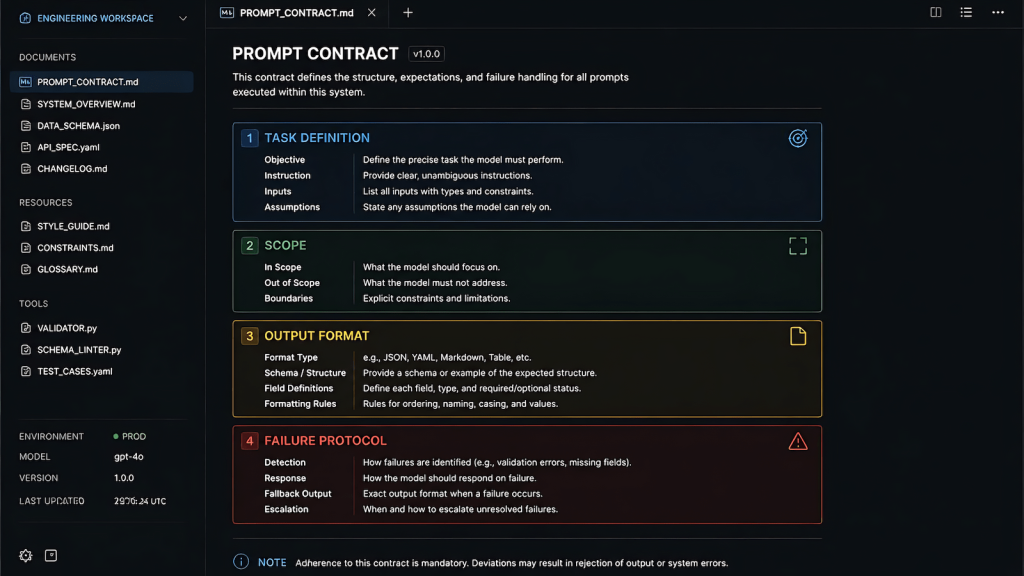
Prompt contracts are what you write when you need a prompt to work reliably across inputs you haven’t seen yet. A prompt contract defines the task, the scope, the output format, and the failure protocol. The failure protocol is the part most prompts skip. What should the model do when the input doesn’t fit the defined scope? Without that specification, the model decides, and its decision is often wrong.
The structure is the same as a software contract: explicit inputs, explicit outputs, explicit behavior at the boundary. A prompt without a failure protocol is a function without error handling. It works until it doesn’t, and when it doesn’t, you find out at the worst possible time.
Prompt contracts are not only for complex automated systems. Any prompt you use more than once on variable inputs benefits from the structure. The editorial auditor prompt is a real example of this in practice: a structured prompt that applies consistent editorial standards across variable content without drifting based on what the content happens to be.
Context Engineering
Context engineering is what prompt engineering was supposed to be. The distinction matters. Prompt engineering, as most people practice it, is about how you phrase the request. Context engineering is about what the model sees before it answers. Those are different variables, and context is the more powerful one.
A model given a rich, well-structured context window and a simple instruction will outperform the same model given a vague context and an elaborately crafted prompt. The quality of the output correlates more strongly with what surrounds the question than with how the question is phrased. Context engineering is the discipline of managing that surrounding structure systematically.
This is why the context engineering post is EAI’s most-viewed piece in this cluster. It names the shift that practitioners feel but haven’t labeled: the point where tweaking prompt wording stops producing improvements and restructuring the context window starts producing them.
Making AI Useful in Systems
LLM optimization for discoverability is what happens when prompt engineering thinking is applied at the content layer rather than the conversation layer. The same principles apply: structure, clarity, and explicit signal about what the content is and what it covers determines how reliably the system (in this case an LLM crawler) produces the right output.
Prompt engineering that actually works at the system level is the same discipline as prompt engineering that works at the conversation level. Explicit scope, explicit format, explicit failure handling. The only difference is scale.
Where to Go From Here
Start with first principles if you’re new to systematic prompting: Prompt Engineering Is Just Asking Better Questions
Add the friction layer: Stop Prompting for Answers, Prompt for a Fight
Build prompts that hold under edge cases: Prompt Contracts: How to Write AI Instructions That Don’t Break
Move to context engineering: Context Engineering for LLMs: What It Is and Why It Beats Prompt Tweaking
Apply it to real systems: The Simplest Way to Improve Your Chatbot Experience and How We Built an Editorial Auditor Prompt That Works Like a Human Editor