“Entry-level AI job: five years of TensorFlow, PhD required.”
You’ve seen those listings. They’re not real. They’re unicorn postings companies throw up as bait usually written by HR with no clue what the team actually needs. The side effect is worse: smart people get discouraged before they even start.
The truth is you don’t need a PhD, or five years of experience you can’t possibly have. You need proof that you can deliver value, the kind that recruiters, hiring managers, and technical leads actually recognize. That proof comes from building, showing, and adapting.

Portfolios Beat Paper
Let’s get this straight: a Coursera certificate or a bootcamp badge is just paper. Recruiters might glance at it, but hiring managers want proof of work.
- GitHub Projects: Doesn’t matter if it’s small. A working repo with a README that explains what you did is more valuable than a “completed course” badge.
- Readable Code: Employers don’t expect genius, but they expect clarity. If they can run your notebook without a headache, you’re already above half the applicants.
- Explanations > Execution: Write your thought process into your project notes. “I chose Random Forest here because…” is stronger than just dumping model code.
You’ll be lucky if you find a company that actually looks at how you solve problems instead of just filtering by credentials. I’ve seen it firsthand one QA job post I wrote blew up, not because I asked for Ivy League pedigrees, but because I focused on how candidates approached the work. The same principle applies here: a hiring manager who sees you explain your process in a GitHub repo is far more likely to give you a shot than one who just reads “completed course.”
Certificates signal you studied. Portfolios prove you can execute. One gets skimmed, the other gets clicked.
Transitional Roles Win Faster
Most people fail to land in AI because they shoot for the wrong job title. Nobody’s handing you “AI Scientist” on day one. The smarter path is lateral.
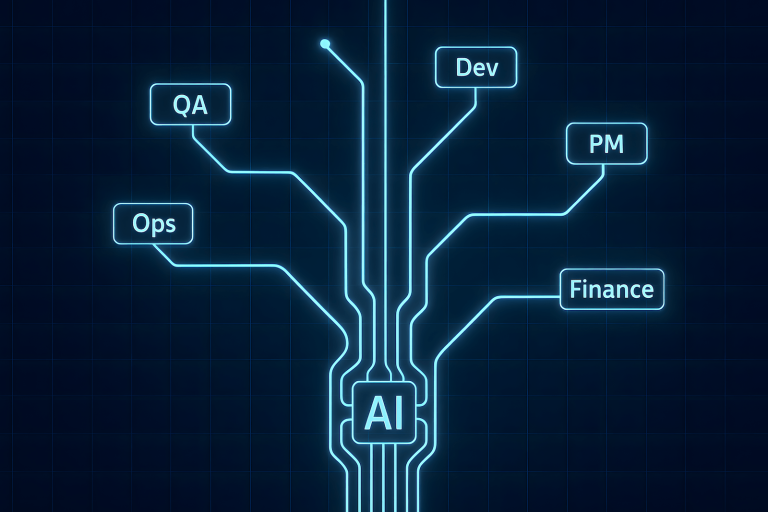
- Data Analyst → ML Associate: You already work with numbers, queries, and dashboards. Add predictive modeling, and you’ve pivoted.
- QA → AI Testing: Test cases and edge cases translate directly into LLM validation and ML stress testing.
- PM → AI Product Owner: You know delivery and scope. Add AI awareness, and you become the bridge between devs and execs.
- Ops → MLOps Pipeline Manager: You already run infra. Now you manage models, retraining, and monitoring.
Transitional roles don’t just get you hired faster, they keep you employed. While everyone else is chasing job titles they’ll never land, you’re stacking experience that compounds.
You can’t land an AI job without showing you’ve actually done the work. If you’re still building your foundation, start with the AI roadmap — Python, frameworks, APIs, and portfolio proof. That baseline makes transitional roles easier to grab because you’re not pretending, you’re proving.
Open Source > Endless Applications
Cold applying 200 times on LinkedIn is wasted effort. Contributing to open source or freelancing even once is stronger leverage.
- Open Source Contributions: Fixing bugs or adding features to an ML repo gets your name into communities recruiters trust.
- Freelance Proof: A single Upwork project or small client job proves that someone paid for your skills. Employers take that seriously.
- Community Presence: Writing up what you contributed, blog, Gist, or even a LinkedIn post, it builds visibility without begging for it.
Instead of “hoping to get noticed,” you put proof in public where it can’t be ignored.
Adaptability > Static Skills
AI in 2025 is moving too fast for a rigid résumé. Listing “expert in TensorFlow” since 2018 doesn’t impress anyone. Showing that you’ve picked up Ollama, GPT4All, or LangChain in the last six months does.
Employers don’t want an encyclopedia. They want proof you can adapt and keep learning without waiting for permission. Even a small two-week sprint experimenting with a new API is more credible than clinging to old tech on your résumé.
What to Ignore
- Cold-apply spamming without portfolio links → recruiters won’t chase you for proof.
- LinkedIn clout-chasing → likes don’t get you hired. Deliverables do.
- Obsession with job titles → “AI Engineer” means nothing if you don’t know the stack they’re using. Focus on fit, not titles.
Ignore the noise. Focus on proof.
Why This Matters
Hiring in AI isn’t a theoretical exercise. It’s companies asking: Can this person help us ship, improve, or maintain AI-driven products today?
Your value isn’t in buzzwords. It’s in the proof you leave behind:
- A repo that runs.
- A project that solved a real problem.
- A portfolio that shows adaptability.
- A contribution that proves teamwork.
That’s what gets you called back. That’s what gets you hired.
The Bottom Line
You don’t need a PhD, five years of TensorFlow, or a miracle bootcamp to land in AI. You need proof of execution. Build small, visible projects. Take transitional roles instead of chasing titles. Contribute where it counts. Show adaptability instead of clinging to outdated stacks.
The job market is broken, but the system for proving your value isn’t. Portfolios beat paper. Contributions beat clout. Adaptability beats résumés. That’s how you get hired in AI without the nonsense.

Chaos Engineer of EngineeredAI.net. Knows firsthand that résumés padded with credentials mean nothing if you can’t solve problems. Once wrote a QA job post that went viral for the same reason, proof of thinking beat pedigrees.
At EAI, he tears down AI tools, workflows, and hiring myths with the same lens: if it can’t run, it doesn’t matter. No fake “entry-level PhD required” nonsense, just systems that prove themselves in practice.