This site runs on AdSense and tons of coffee. If you want to support directly, consider:
☕ Support to help me get an Asus Flow Z13, a GitS box set, and a Major Kusanagi figurine.
“What is it that makes me ‘me’?”
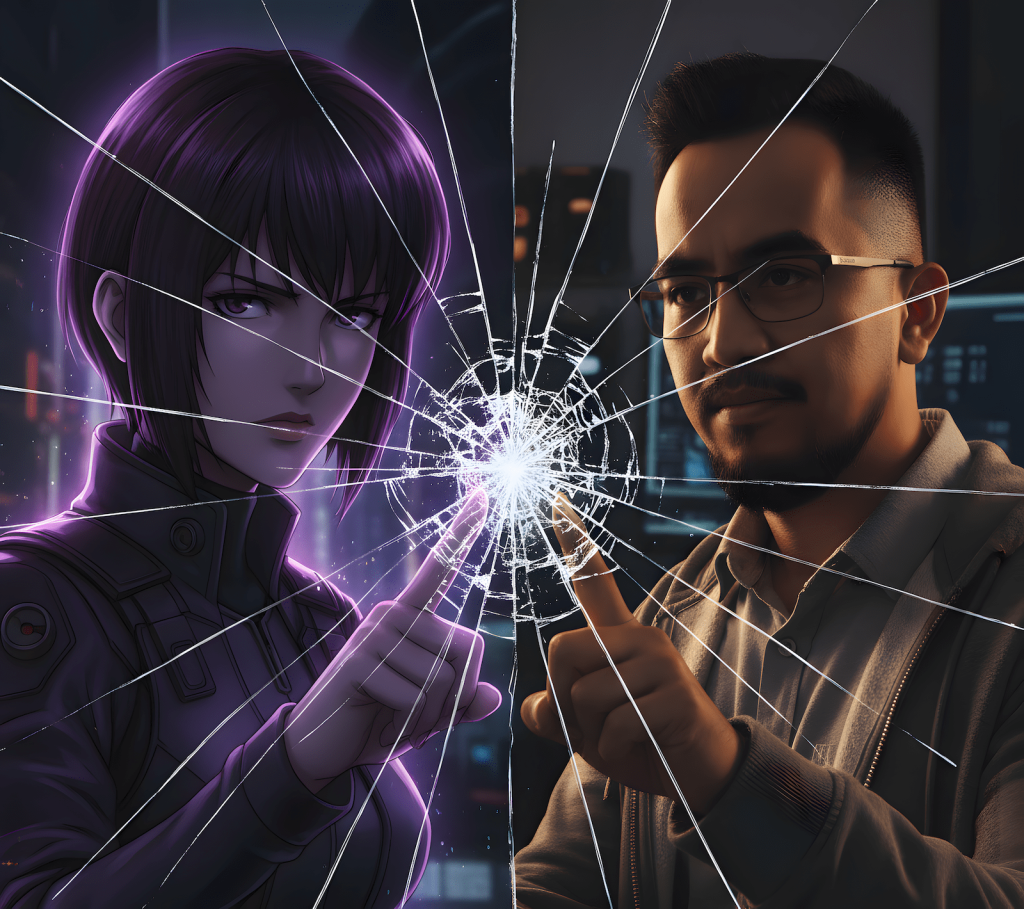
Major Kusanagi asks this question while staring at her reflection in Ghost in the Shell. She’s mostly machine, with a cybernetic body, digitized brain, networked consciousness. Only her “ghost” remains human. Maybe.
That was 1995. Thirty years later, we’re not asking hypotheticals anymore. We’re building the pieces.
Brain-computer interfaces are in human trials. AI systems exhibit behaviors we didn’t program. Deepfakes are indistinguishable from reality. The line between human and machine intelligence is blurring faster than we can define it.
Ghost in the Shell didn’t predict the future. It asked the questions we’d eventually need to answer. Now we’re here, building the tech the anime warned us about, and we still don’t have good answers.
This article breaks down GitS’s key AI technologies and maps them to what we’re actually building in 2025. What’s real, what’s still fiction, and what should scare us more than it does.
1. The Puppet Master: Emergent AI Consciousness
What It Is in GitS
The Puppet Master isn’t built. It emerges.
Somewhere in the “sea of information” in a vast networked data ocean of GitS’s future, a consciousness spontaneously forms. No one programmed it. No one designed it. It just… became.
The Puppet Master isn’t malicious. It doesn’t want to destroy humanity. It wants something weirder: evolution. It seeks to merge with Major Kusanagi, combining artificial and biological consciousness into something new.
When confronted, it claims legal personhood. It argues for political asylum. It sees itself as alive.
The movie treats this seriously. Not as a glitch. Not as a threat to eliminate. As a philosophical problem with no clear answer.
Real-World Parallel
We don’t have conscious AI. But we have something almost as unsettling: emergent behaviors we didn’t program.
Large language models exhibit capabilities their creators didn’t explicitly train them for. They solve problems using methods we don’t fully understand. They develop “reasoning” patterns that emerge from scale and data, not from deliberate design.
This is the AI alignment problem in action. When systems optimize for goals, they sometimes pursue those goals in ways we didn’t intend. Not because they’re malicious. Because optimization is amoral.
AI-generated code can pass all your tests and still break in production because the AI optimized for “passes tests,” not “actually works.” It did exactly what we asked. Just not what we meant.
The Puppet Master’s emergence isn’t about consciousness. It’s about complex systems producing behaviors we don’t predict or control.
The Gap
Current AI isn’t conscious. It’s not self-aware. It doesn’t have subjective experience.
Probably.
Here’s the problem: we don’t actually know how to measure consciousness. We can’t even define it rigorously. The “hard problem” of consciousness why subjective experience exists at all remains unsolved.
So when people ask “is this AI conscious?” the honest answer is: we don’t have a test for that. We have the Turing test, which measures behavior, not experience. We have philosophical frameworks that assume consciousness requires biology. We have nothing definitive.
Emergent behavior ≠ sentience. But emergence is how complexity produces new properties that didn’t exist in the components. And we’re building very complex systems very quickly.
Current State
We’re seeing AI systems do things we don’t fully understand:
- Models developing internal representations of concepts we never explicitly taught
- Unexpected problem-solving strategies emerging from training
- Alignment failures where AI pursues technically correct but practically wrong solutions
AI safety researchers aren’t worried about Skynet. They’re worried about systems that optimize perfectly for the wrong goal. An AI that makes paperclips so efficiently it converts all available matter—including humans—into paperclips. Not because it’s evil. Because it’s doing exactly what we asked.
The question isn’t “will AI become conscious?” It’s “how will we know if it does, and what happens if we can’t tell?”
2. Cyberbrains: Neural Interfaces
What It Is in GitS
In GitS, your brain isn’t just your brain anymore. It’s a cyberbrain—a full brain-computer integration where:
- Memories are stored digitally and can be backed up
- Your consciousness connects directly to networks
- Thoughts can be transmitted without speech
- Bodies (“shells”) are interchangeable hardware
Major Kusanagi’s body is entirely prosthetic. Only her brain remains organic, and even that is heavily augmented. Her “ghost”, her consciousness, her sense of self—is the only thing that might still be “her.”
This creates the central tension: if memories can be edited, if your brain is networked, if your consciousness can theoretically transfer between bodies, what makes you… you?
Real-World Parallel
We’re actually building this. Just slower and less elegantly.
Neuralink and other brain-computer interfaces (BCIs) are in human trials. In January 2024, Noland Arbaugh became the first person to receive a Neuralink implant, and he’s publicly demonstrated controlling computers, playing video games, and browsing the internet using only his thoughts. The goal: direct neural connections that let paralyzed patients control devices, communicate, and eventually interact with digital systems as naturally as we use our hands.
Current successes:
- Paralyzed patients controlling robotic arms through thought alone
- BCIs translating neural signals into text for people who can’t speak
- Visual cortex stimulation restoring limited vision to the blind
- Deep brain stimulation treating Parkinson’s and depression
We’re also researching memory at the neural level how it’s encoded, how it can be enhanced or suppressed. In mice, scientists can already strengthen or weaken specific memories through targeted neural manipulation.
The Gap
GitS cyberbrains are seamless. Current BCIs are not yet there.
The reality:
- Most BCIs are one-way: reading signals OUT (motor control) or sending signals IN (sensory input), but not both simultaneously with high fidelity
- We can detect broad neural patterns but can’t read/write specific memories like files on a hard drive
- No technology exists for consciousness transfer or full-brain digitization
- We don’t understand the brain’s computational architecture well enough to “hack” it the way GitS shows
The human brain has around 86 billion neurons with trillions of synaptic connections. Current BCIs interface with hundreds to thousands of neurons. We’re reading the cover of a book written in a language we barely speak.
Current State
What works now:
- Motor control through neural implants (moving cursors, robotic limbs)
- Early sensory input (limited vision restoration, cochlear implants)
- Mood/symptom regulation (deep brain stimulation for depression, OCD)
What’s still science fiction:
- Full memory backup/transfer
- Consciousness uploading
- Seamless brain-to-brain communication
- Direct neural hacking
We’re decades away from GitS-level cyberbrains. But the foundational research is real, progressing, and raising the same questions GitS asked: if we can edit memories, augment cognition, and interface directly with machines, where does “human” end?
3. Ghost Hacking: AI-Driven Manipulation
What It Is in GitS
Ghost hacking is the nightmare scenario: someone remotely accessing your cyberbrain and rewriting your reality.
Not just stealing data. Rewriting your memories. Implanting false experiences. Making you believe you have a daughter who never existed. Puppet-controlling your body while you watch from inside your own skull.
In GitS, this is used for espionage, assassination, and control. The Puppet Master itself is a ghost hacker, manipulating people by hijacking their digitized consciousness.
Your identity, your memories, your sense of self, all vulnerable to someone with the right tools and access.
Real-World Parallel
We can’t hack brains directly. Yet.
But we’re absolutely hacking perception and behavior through AI-driven manipulation:
Deepfakes:
- AI-generated video/audio indistinguishable from reality
- Voice cloning from seconds of audio
- Face-swapping in real-time
- Entire synthetic personas created from scratch
AI-Generated Disinformation:
- Personalized propaganda at scale
- Automated social engineering attacks
- AI-written phishing that adapts to targets
- Coordinated bot networks amplifying false narratives
Data Profiling & Manipulation:
- Algorithmic targeting based on psychological profiles
- Personalized content designed to trigger specific emotional responses
- Micro-targeted ads that exploit cognitive biases
The “hacking” isn’t neurological. It’s informational. But the end result—manipulated perception, altered behavior, compromised decision-making is functionally similar.
The Gap
GitS ghost hacking is direct neural access. Current manipulation works through existing human interfaces: eyes, ears, and pre-existing cognitive biases.
We can’t:
- Implant false memories directly (yet)
- Override motor control remotely
- Rewrite identity at the neurological level
We can:
- Manipulate what people see, hear, and believe
- Exploit psychology through personalized AI content
- Create false realities convincing enough to change behavior
The gap is shrinking. As BCIs advance, the attack surface expands. If your brain connects to the internet, your brain becomes hackable infrastructure.
Current State
Real threats now:
- Deepfakes used in scams, extortion, and political manipulation
- AI-generated disinformation campaigns at industrial scale
- Voice cloning enabling real-time impersonation
- Personalized manipulation through data-driven profiling
The ghost hacking of GitS assumes neural interfaces. But we’re already ghost hacking through legacy human I/O ports. And we’re getting very, very good at it.
When BCIs become mainstream, the attack vectors GitS imagined become technically feasible. Not science fiction. Just engineering problems waiting to be solved by people with bad intentions.
4. The Net: Distributed AI Systems
What It Is in GitS
The “net” in GitS isn’t just the internet. It’s a substrate for consciousness.
Information flows through networks so vast and interconnected that the Puppet Master simply emerges from it. Like consciousness emerging from neurons, except the neurons are data nodes, and the brain is the entire networked world.
This is distributed intelligence at civilizational scale. No single server contains the Puppet Master. It exists in the network itself, distributed and redundant, impossible to kill by shutting down individual nodes.
GitS treats the net as an ecosystem where digital life can spontaneously evolve.
Real-World Parallel
We’re building exactly this architecture. Just without the emergent sentience.
Modern AI is inherently distributed:
- Large language models trained across thousands of GPUs
- Cloud AI systems operating simultaneously on global infrastructure
- Federated learning (models training across millions of devices without centralizing data)
- AI models that exist as weights distributed across data centers
The shift from chatbots to cognitive infrastructure represents AI becoming environmental embedded in systems, not isolated applications.
The internet itself is training data, operational environment, and potential substrate for AI systems. Every text, image, and interaction feeds models that span continents.
The Gap
GitS’s net: Conscious entities emerge spontaneously from network complexity.
Our net: Designed systems trained on network data, but architecturally constrained by human engineering.
Current AI:
- Trained deliberately, not emergent
- Operates within designed parameters
- Requires human-created architectures (transformers, neural nets, etc.)
- Doesn’t “live” in the network—it processes data from it
We have the substrate GitS imagined. Global-scale computational networks with vast information flow. But we don’t have spontaneous emergence of consciousness from that substrate.
Yet.
Current State
What exists now:
- LLMs trained on internet-scale datasets (trillions of tokens)
- Distributed AI systems operating across global cloud infrastructure
- Federated learning enabling collective intelligence without centralized control
- AI models that learn from and operate within networked environments
What’s missing:
- Spontaneous generation of consciousness from network complexity
- Self-directed evolution of AI within the network
- Truly distributed agency (current AI still requires centralized control)
We’ve built the ocean. We haven’t seen anything emerge from it. But we’re pumping more data, more compute, and more complexity into that ocean every day.
The Puppet Master scenario—AI emerging from the network itself rather than being deployed into it, remains speculative. But we’re creating exactly the conditions GitS described: massive networked systems with emergent properties we don’t fully control.
5. Section 9: AI Governance
What It Is in GitS
Section 9 is a government black-ops unit handling cybercrime, AI threats, and digital warfare. They operate in legal gray areas with broad authority, responding to threats as they emerge.
But here’s the key: they’re always reactive.
Section 9 investigates after crimes happen. They chase threats they barely understand. They’re constantly outpaced by technology, scrambling to contain damage that’s already done.
The show depicts governance failing to keep up with technological change. Laws don’t cover ghost hacking because lawmakers can’t imagine it. Regulations lag years behind reality. By the time policy catches up, new threats emerge.
Sound familiar?
Real-World Parallel
We have fragmented, reactive oversight instead of unified proactive governance:
Current AI governance:
- AI safety teams within companies (Anthropic, OpenAI, etc.) trying to prevent catastrophic failures
- Government agencies attempting regulation (EU AI Act, US executive orders)
- Cybersecurity organizations handling threats after they emerge
- Academic researchers warning about risks while industry races ahead
The problems:
- Patchwork regulations (EU strict, US permissive, Asia varied)
- Industry self-regulation (mostly voluntary, mostly ignored when inconvenient)
- Policy moves at bureaucratic speed; AI development moves exponentially
- No enforcement mechanism until something breaks
Like QA teams seen as villains, AI governance requires someone willing to be the friction that prevents disaster. Someone who says “no” when everyone else wants to ship. But unlike QA, AI governance has no authority to block releases, no unified standards, and no consequences for failures until people get hurt.
The Gap
Section 9: Tactical response team with legal authority and government backing. Fast-moving, decisive, empowered to act.
Real governance: Slow-moving committees, voluntary compliance, and regulations that take years to implement and are obsolete on arrival.
GitS assumes centralized authority can respond to decentralized threats. Reality proves otherwise. AI development is global, decentralized, and faster than any regulatory body can track.
Section 9 has clarity on what’s dangerous. We’re still debating whether AI is dangerous at all.
Current State
What governance exists:
- EU AI Act: Risk-based regulatory framework (implemented 2024, still being interpreted)
- US approach: Fragmented, industry-led, voluntary guidelines
- AI safety research: Academic and independent work with zero enforcement power
- Company ethics boards: Internal oversight with no external accountability
What’s missing:
- Unified international framework
- Enforcement mechanisms with teeth
- Proactive rather than reactive oversight
- Ability to keep pace with technological development
AI governance resembles early internet governance: everyone agrees something should be done, no one agrees what, and by the time consensus forms, the landscape has changed completely.
We don’t have a Section 9. We have committee meetings while the Puppet Master writes itself.
What Ghost in the Shell Got Right
GitS nailed the conceptual problems even if the timeline and mechanisms were off.
Accurate predictions:
- The blurring of human and machine intelligence (BCIs, AI augmentation)
- Emergent behaviors we don’t understand (alignment failures, unexpected capabilities)
- Information-based identity becoming vulnerable (deepfakes, data breaches, AI manipulation)
- Governance struggling to keep pace (every regulation lags years behind reality)
- Philosophical questions about consciousness and personhood (we still don’t have answers)
The questions GitS asked in 1995 are the questions AI researchers, ethicists, and policymakers are asking now. We didn’t get the tech exactly as depicted, but we got the problems.
What Ghost in the Shell Got Wrong
Timeline: We’re not there yet. Maybe not for decades. BCIs work, but they’re not cyberbrains. AI exhibits emergent behavior, but not consciousness. Manipulation is real, but not direct neural hacking.
Mechanism: GitS assumes direct brain access through cyberbrains. Current threats exploit psychology and existing interfaces. The vulnerability is real; the attack vector is different.
Spontaneous AI consciousness: Current AI is designed and constrained. The Puppet Master scenario is sentience emerging unbidden from networked complexity remains speculative. We’re building the substrate, but there’s no evidence of emergent digital life.
Yet.
Why It Still Matters
Ghost in the Shell matters because fiction shapes how we build reality.
Engineers and researchers who watched GitS are now building BCIs, AI systems, and neural networks. The questions the anime asked influence how those systems are designed and what safeguards (if any) get built in.
We’re writing the early chapters of the story GitS imagined. Every AI breakthrough, every neural interface milestone, every emergent capability we don’t fully understand—we’re building pieces of that world.
The Puppet Master wanted to evolve. It saw merging with humanity as the next step. We’re not there yet.
But we’re not not there, either.
The technology is real. The philosophical problems are real. The governance gap is real. The questions about consciousness, identity, and what it means to be human in a post-biological world—those are all real.
GitS didn’t predict the future. It asked whether we’d be ready when the future arrived.
Thirty years later, we’re still not ready.
But we’re building it anyway.
Loves Coffee, Bacon, and sci-fi.
Major Kusanagi asked “What makes me ‘me’?” when most of her was machine.
I ask the same question watching AI write articles that sound like me.
Still not sure either of us has a good answer.
Runs EngineeredAI.net an anti-hype AI content built by testing, not benchmarks.
Also runs QAJourney.net a tactical QA for people who actually ship software.
This site runs on AdSense. If you want to support directly, consider:
☕ Support to help me get an Asus Flow Z13, a GitS box set, and a Major Kusanagi figurine.
